


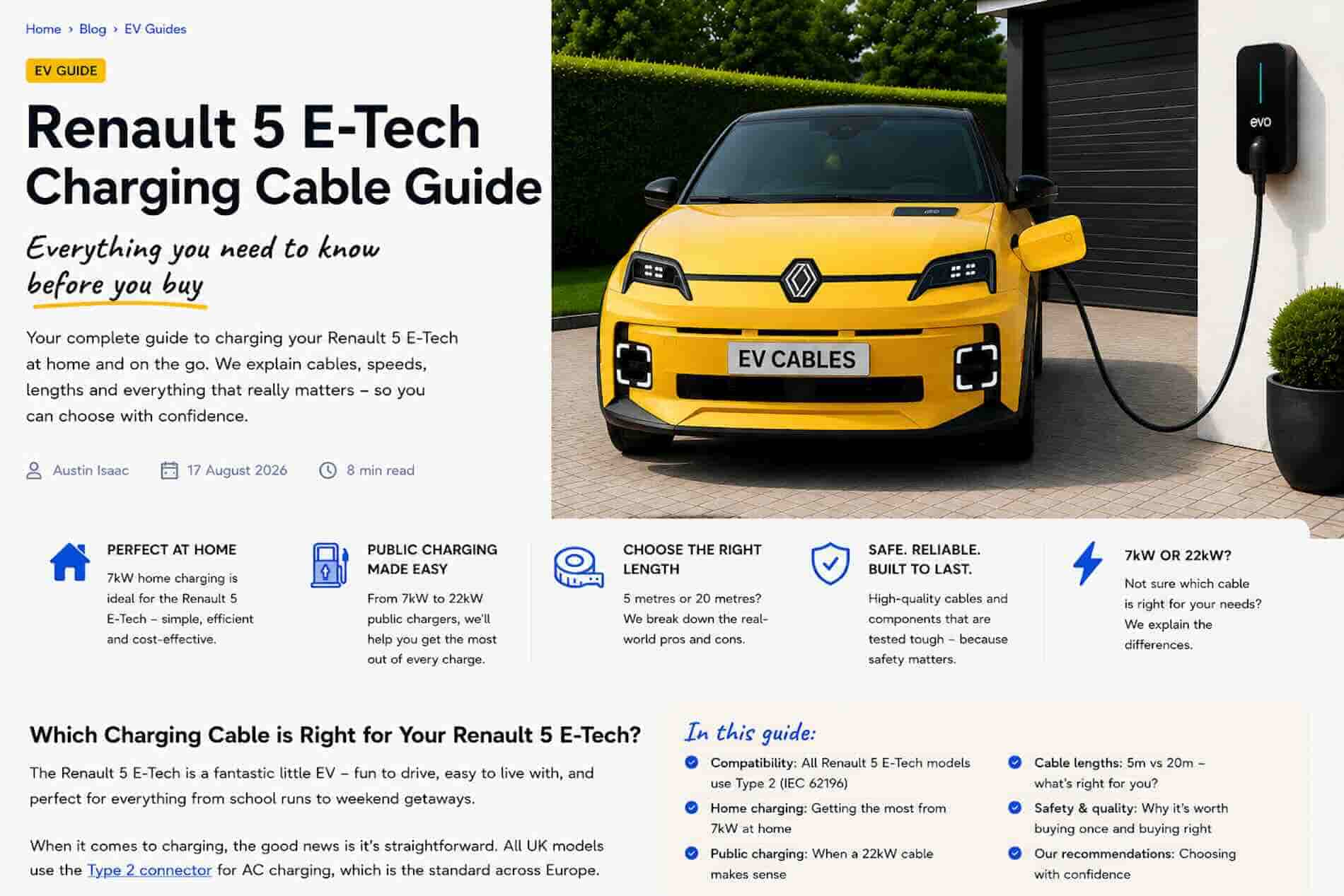
Renault 5 E-Tech Charging Cable Guide: 7kW, 11kW & Type 2 Explained
The Renault 5 is back - although this time there isn't a petrol engine under the bonnet.
And judging by the number appearing on British roads, Renault seems to have got the formula right. The Renault 5 E-Tech was Britain's best-selling electric car in April 2026, according to SMMT registration data.
It's small, distinctive and refreshingly different from many of the larger electric SUVs currently dominating the market. But if you've recently bought one - or you're waiting for yours to arrive - you'll probably have encountered the usual collection of EV charging numbers:
7kW, 11kW, 22kW, 32A, single phase, three phase, Type 2...
It sounds more complicated than it actually is.
The Renault 5 E-Tech uses a Type 2 connection for AC charging and has an 11kW onboard AC charger. The important bit isn't simply buying the cable with the biggest number printed on it - it's choosing one that suits where and how you actually charge.
So, let's make sense of it.
What Charging Cable Does the Renault 5 E-Tech Use?
For normal AC charging, the Renault 5 E-Tech uses a Type 2 to Type 2 charging cable.
Type 2 is the standard AC connection you'll encounter across the UK and Europe. It's the cable you'll use with an untethered home wallbox, workplace charger, hotel charger or public AC charging point.
Renault's current UK information lists a Mode 3 Type 2 charging cable, with equipment potentially varying according to vehicle specification.
So why might you want another one?
Perhaps you'd prefer a longer cable because your wallbox isn't conveniently positioned. Maybe you want one cable permanently at home and another in the boot. Or you've bought a used Renault 5 and need a replacement.
Whatever the reason, your first real decision is whether a 7kW single-phase or 22kW three-phase Type 2 cable better suits how you charge.
Browse all Type 2 EV charging cables
Understanding the Renault 5's 11kW Onboard Charger
This is probably the most important thing to understand before choosing a cable.
The Renault 5 E-Tech has an 11kW onboard AC charger.
That doesn't mean you need to find an "11kW cable", and plugging into a 22kW charging point won't suddenly make the car charge at 22kW.
Charging speed is effectively determined by the lowest limit in the chain:
Charging point → Charging cable → Vehicle
So, in practical terms:
- 7.4kW home charger → up to around 7.4kW
- 11kW three-phase charger → up to 11kW
- 22kW three-phase charger → still up to 11kW
The Renault 5 itself is the limiting factor in the final example. Its onboard AC charger can accept a maximum of 11kW, even though the charging station and cable may be capable of supplying considerably more.
And that's why choosing between a 7kW and 22kW cable is really about where you're going to use it.
Charging Your Renault 5 at Home: Is a 7kW Cable Enough?
For many Renault 5 owners, absolutely.
Most UK homes have a single-phase electricity supply, and a typical dedicated EV wallbox provides around 7kW to 7.4kW at 32A.
In that situation, a 32A single-phase Type 2 charging cable is a very good match for the Renault 5.
Buying a three-phase 22kW cable won't make the car charge any faster from a 7kW wallbox because the wallbox itself is already the limiting factor.
There's another practical advantage too: a single-phase cable has fewer conductors inside, so it's generally lighter and easier to handle than an equivalent three-phase cable.
If your Renault spends most nights plugged into the same charger on your driveway, there's little reason to carry around more cable than you need.
Best for: home charging, regular overnight charging and drivers who rarely use untethered three-phase public AC chargers.
Browse our 7kW 32A Type 2 charging cables
Public Charging: When a 22kW Cable Makes Sense
This is where the Renault 5's 11kW onboard charger becomes more useful.
Public AC charging points rated at 11kW or 22kW are common at workplaces, hotels, shopping centres, car parks and other destination charging locations.
To make use of the Renault's full 11kW three-phase AC capability, you'll need an appropriately rated three-phase Type 2 cable.
A 22kW 32A three-phase Type 2 cable does exactly that.
The terminology can sound slightly odd at first.
A 22kW cable will not make your Renault 5 charge at 22kW.
Instead, it gives the car access to all three phases of the charging supply, allowing its onboard charger to draw the maximum 11kW it was designed to accept.
There's also a useful bonus: a 22kW Type 2 cable can still be used on lower-powered Type 2 charging points.
So if you want one cable to use both at home and when travelling, three-phase is arguably the more versatile option.
Browse our 22kW 32A three-phase Type 2 charging cables
7kW or 22kW Cable for a Renault 5?
There's no need to automatically buy the cable with the largest number printed on the label.
Choose according to how you actually use the car.
| How you charge | We'd choose |
|---|---|
| Mainly 7kW home charging | 7kW single-phase |
| Home + occasional public DC rapid charging | 7kW is probably enough |
| Regular public AC charging | 22kW three-phase |
| Regular workplace/destination charging | 22kW three-phase |
| One cable for home and public AC use | 22kW three-phase |
| Maximum flexibility for your next EV | 22kW three-phase |
Remember that DC rapid charging is different. Rapid chargers provide their own tethered cable, so the Type 2 cable you carry in the boot isn't involved.
How Much Difference Does 11kW Charging Actually Make?
Quite a bit — provided you're somewhere that can supply it.
Renault publishes the following indicative 15–80% AC charging times:
| Renault 5 battery | 7.4kW AC | 11kW AC |
| 40kWh Urban Range | 3h 55m | 2h 37m |
| 52kWh Comfort Range | 5h 11m | 3h 13m |
At home overnight, that difference probably doesn't matter much.
Plug in when you get home, go to bed and both provide plenty of time to replenish the battery.
But arrive at a hotel, workplace or destination charger with a low battery and suddenly being able to take 11kW rather than 7kW becomes considerably more useful.
That's the strongest reason we'd recommend a three-phase cable to Renault 5 owners who expect to use public AC charging regularly.
What Length Charging Cable Is Best for the Renault 5?
There's no perfect cable length because everyone's driveway, garage and charging routine is different.
This is one area where we'd resist automatically choosing the shortest cable simply because it's cheaper.
5 Metres - Simple and Easy to Handle
If your wallbox is mounted close to where you park and you're confident you'll always have straightforward access, 5 metres is normally plenty.
It's compact, lighter to handle and takes up less room when stored.
7.5 Metres - The Everyday Sweet Spot
For many drivers, 7.5 metres is our favourite all-round option.
That extra 2.5 metres doesn't sound like much, but it provides useful breathing room when a public charging post is awkwardly positioned or another vehicle prevents you parking exactly where you'd like.
10 Metres - Extra Flexibility
If your charger isn't immediately beside the car, or you regularly charge away from home, 10 metres gives considerably more freedom over where you park.
It's also useful when you don't know whether the charging post will be beside, behind or several metres away from the car.
15 & 20 Metres - When You Genuinely Need the Reach
Longer isn't automatically better.
But shared driveways, rented properties, awkward parking arrangements and wallboxes installed some distance from the vehicle can make 15m or 20m invaluable.
One thing we wouldn't recommend is buying a cable that's too short and assuming you can simply extend it later. EV charging cables shouldn't be daisy-chained together.
A cable that's slightly longer than you need is rarely a problem.
One that's half a metre too short is useless.
See our Type 2 charging cable lengths and options
Cable Quality & Safety: What Should You Look For?
A charging cable doesn't have a particularly glamorous life.
It gets dropped on driveways, dragged across car parks, coiled into boots and used outdoors throughout the British winter.
That's why we'd look beyond price alone.
A properly manufactured EV charging cable should use components designed specifically for repeated EV charging, including suitable Type 2 connectors, correctly sized conductors, robust strain relief and an EV-specific flexible cable.
Our Type 2 cables are manufactured for vehicles using the IEC 62196 Type 2 charging standard and are designed for regular outdoor use.
We've also spent more than a decade developing and improving our own Type 2 connectors. Our current design is the third generation, incorporating improvements based on manufacturing experience and feedback from real-world use.
That includes details such as robust connector construction, comfortable handling, proper cable strain relief and our downward-facing protective plug covers, designed to help shield the connector pins from rain, dirt and debris when the cable is stored.
None of those features make the car charge faster.
They're about making a cable easier to live with and more dependable over years of regular use.
What About DC Rapid Charging?
Here's the easy one:
You don't need to bring a cable.
DC rapid chargers have their own charging cable permanently attached to the charging station.
The Renault 5's 40kWh battery supports up to 80kW DC, while the 52kWh Comfort Range battery supports up to 100kW DC.
Renault quotes approximately 31 minutes and 30 minutes respectively for a 15–80% charge under suitable conditions.
Your portable Type 2 cable is therefore for AC charging - at home, work or an untethered public charger - rather than motorway-style DC rapid charging.
One Cable at Home and Another in the Boot?
It sounds extravagant until the morning you drive away and realise your charging cable is still hanging beside the wallbox.
If you regularly use an untethered home charger, keeping one cable permanently at home and another in the car can be surprisingly convenient.
Our preferred combination would be:
At home: a 7kW single-phase cable in whatever length comfortably reaches your normal parking position.
In the boot: a 7.5m or 10m 22kW three-phase cable.
The home cable stays where you need it, while the cable travelling with the car gives you access to the Renault 5's full 11kW AC capability whenever you encounter a suitable three-phase public charger.
Our Renault 5 E-Tech Cable Recommendations
If you just want the simple answer, we'd narrow it down like this:
Mostly charging at home?
Choose a 7kW 32A single-phase Type 2 cable.
Using a mixture of home and public AC charging?
Choose a 22kW 32A three-phase Type 2 cable.
Want one cable to cover almost every AC charging situation?
We'd choose a 22kW three-phase Type 2 cable in 7.5m or 10m.
Have an awkward driveway or distant wallbox?
Measure the actual route the cable needs to take from the charging point to the Renault's charging port - not simply the straight-line distance - and choose the appropriate longer cable.
Ultimately, the Renault 5 makes things relatively simple. It uses the established Type 2 standard, handles everyday 7kW home charging perfectly well and has the added advantage of an 11kW three-phase onboard charger when faster AC charging is available.
The right cable isn't necessarily the most powerful or the longest.
It's the one that suits where you actually charge.
Find the Right Charging Cable for Your Renault 5 E-Tech
Whether you need a compact cable for the driveway or a longer three-phase cable for home, work and public charging, choose the specification that suits how and where you actually use your Renault 5.
7kW Type 2 charging cables — 32A single-phase


