


JAECOO E5 Charging: Which Type 2 Cable Should You Buy?
The JAECOO E5 hasn't exactly taken long to get noticed.
It’s one of those EVs that seemed to go from “what’s that?” to appearing on UK roads remarkably quickly. And we can see the appeal. It has the chunky SUV styling buyers currently want, plenty of equipment and, perhaps most importantly, it doesn't ask you to spend premium-brand money to get it.
If you've bought one - or have one arriving soon - charging it is actually refreshingly straightforward.
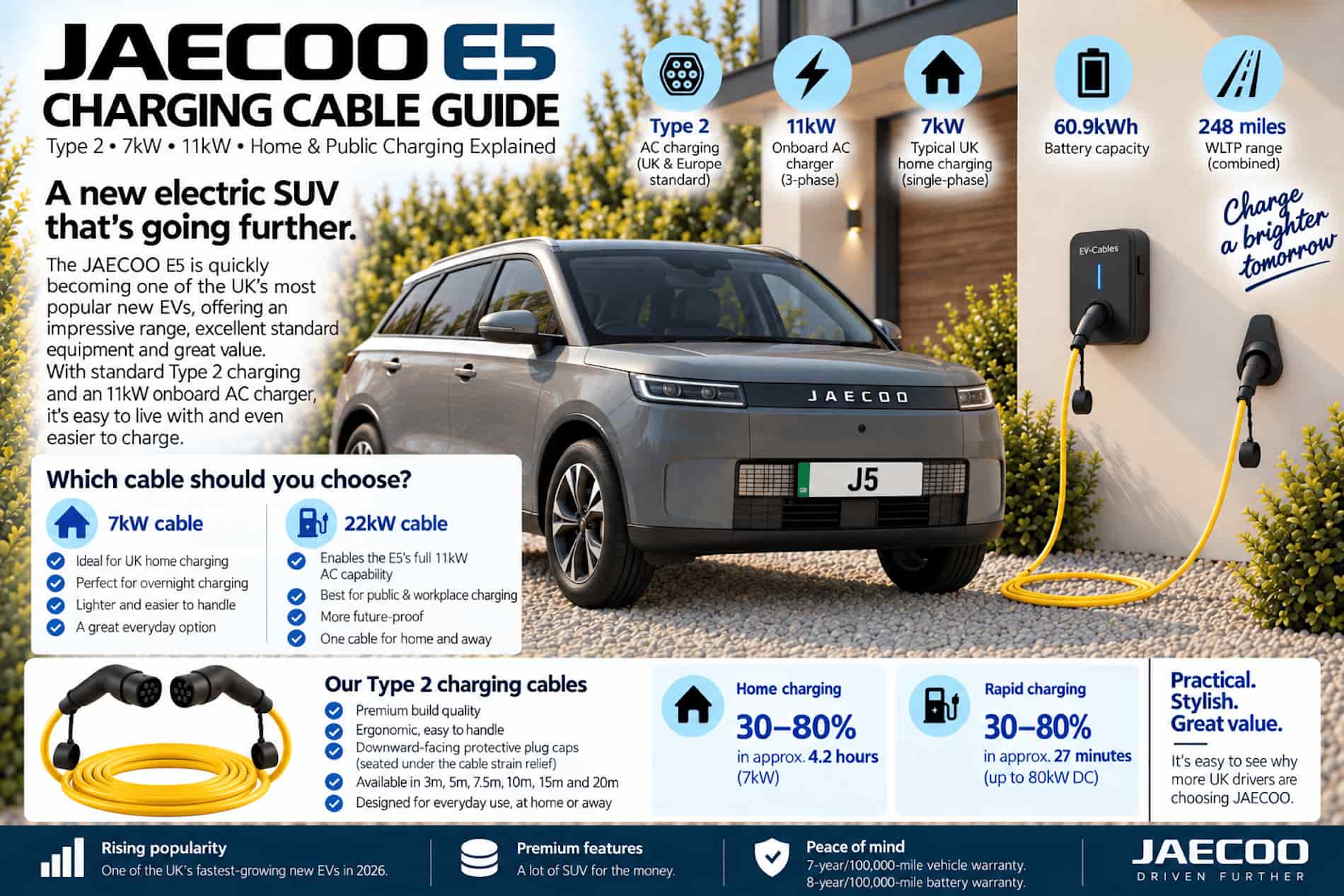
The JAECOO E5 has a 60.9kWh battery, an official 248-mile WLTP range and uses the familiar Type 2 connection for AC charging. JAECOO quotes around 27 minutes for a 30–80% DC rapid charge, while its 11kW onboard AC charger makes it particularly interesting for drivers who also use workplace and public destination chargers.
But that 11kW figure creates an obvious question:
Do you buy a 7kW, 11kW or 22kW charging cable?
The answer is simpler than those numbers make it sound.
What Charging Cable Does the JAECOO E5 Use?
For normal AC charging, the JAECOO E5 uses a Type 2 to Type 2 EV charging cable.
That's the cable you'll use with an untethered home wallbox and with untethered public AC chargers at places such as hotels, workplaces, shopping centres and car parks.
Type 2 is the established AC charging standard across the UK and Europe, so there's nothing unusual or proprietary to worry about with the E5. Our Type 2 EV charging cable range includes both 32A single-phase and 32A three-phase options.
The more interesting decision is which rating of Type 2 cable to buy.
For most JAECOO E5 owners, we'd narrow the choice down to:
- 7kW / 32A single-phase Type 2 - ideal if you mainly charge at home.
- 22kW / 32A three-phase Type 2 - our choice if you regularly use public or workplace AC chargers and want access to the E5's full 11kW AC capability.
And yes, we know that second one sounds odd.
Why buy a 22kW cable for a car that charges at 11kW?
That's where things get interesting.
Can the JAECOO E5 Charge at 11kW?
Yes.
The JAECOO E5 has an 11kW three-phase onboard AC charger.
It's worth understanding what the onboard charger actually does.
When you connect an EV to an AC charging point, the electricity doesn't go straight into the battery. The car's onboard charger converts the incoming AC electricity into the DC electricity the battery needs.
And charging speed is always governed by the weakest link:
Charging point → charging cable → onboard charger
So connect the E5 to a typical UK 7kW wallbox and you'll get roughly 7kW.
Connect it to an 11kW three-phase charger with an appropriate three-phase cable and the car can take up to 11kW.
Connect it to a 22kW AC charger and...
You still get up to 11kW.
The charging point may have 22kW available, but the E5 only takes what its onboard charger can accept.
That's an important distinction because a 22kW cable doesn't make the JAECOO E5 charge at 22kW.
Why Use a 22kW Cable With an 11kW JAECOO E5?
Because what we commonly call a 22kW Type 2 cable is a 32A three-phase cable.
The E5 needs three-phase connectivity to access its 11kW AC charging capability.
A 7kW cable is normally 32A single phase.
A 22kW cable is 32A three phase.
So you're not buying the 22kW cable because you expect the JAECOO to draw 22kW. You're buying it because it carries all three phases required for the car to charge at up to 11kW when connected to a suitable charger.
There's another advantage: a 22kW Type 2 cable is backwards-compatible.
You can use the same cable on a 7kW home wallbox and the car will simply charge at the power available. The vehicle and charge point determine the actual charging power - the cable doesn't force 22kW into the vehicle.
That makes our 22kW three-phase Type 2 charging cables a particularly good choice if you want one cable to leave in the boot and use almost anywhere.
Not sure which cable suits the way you charge? Our JAECOO charging cable guide compares 7.4kW single-phase, 22kW-rated three-phase and portable charging options, together with recommended cable lengths and charging estimates.
Is a 7kW Charging Cable Enough for the JAECOO E5 at Home?
For most UK homes, yes.
And we'd happily recommend one rather than telling everyone they need the biggest cable available.
Most domestic EV charging happens overnight. You arrive home, plug the car in and unplug it the following morning.
JAECOO itself says a full charge overnight is easily achievable using a 7kW home wallbox.
A 32A single-phase Type 2 cable therefore makes a lot of sense if that's how you use your E5.
It also has a physical advantage that often gets overlooked.
A single-phase cable requires fewer power conductors than its three-phase equivalent, so an equivalent-length 7kW cable can be lighter and easier to handle.
That's particularly noticeable once you start looking at longer cables.
If the cable is going to spend most of its life between the same wallbox and the same parking position, we'd choose the simpler option.
Our 7kW Type 2 EV charging cables are designed specifically for this sort of 32A single-phase charging.
How Long Does the JAECOO E5 Take to Charge at Home?
The E5's battery capacity is 60.9kWh, with an official 248-mile WLTP combined range.
At a typical 7kW home charger, think overnight rather than waiting around for it.
In everyday ownership, though, you'll rarely arrive home at 0% and need to charge to 100%.
That's one of the things that gets lost in EV charging specifications.
You don't normally “fill” an EV like a petrol car. You plug it in with charge remaining, add back what you've used and drive away again.
For many E5 owners, the difference between 7kW and 11kW therefore won't matter much at home.
Away from home is another story.
JAECOO E5 Public Charging: When 11kW AC Becomes Useful
Imagine arriving at a hotel at 30%, plugging into an 11kW or 22kW AC charger and heading inside for a few hours.
Now the ability to take 11kW rather than 7kW starts becoming useful.
The same applies at the office, gym, shopping centre or anywhere else where the car sits for a couple of hours rather than overnight.
That's why our cable recommendation changes depending on the owner.
If you're almost exclusively a home charger, we'd choose the 7kW cable.
If you regularly destination-charge away from home, we'd buy the 22kW three-phase Type 2 cable and let the E5 make use of its full 11kW AC capability whenever it's available. A 22kW cable supports 16A three-phase charging at 11kW as well as 32A three-phase charging up to 22kW, while remaining backwards-compatible with single-phase charging.
What Length Charging Cable Is Best for the JAECOO E5?
This is where we'd think about the driveway before thinking about the car.
Don't simply measure the straight-line distance from your wallbox to the charging port. Think about the route the cable actually has to take - and whether you always park in exactly the same position.
3m is compact if your parking position and wallbox are perfectly placed.
5m is a sensible everyday home-charging length where the charger is close to the vehicle. It gives useful flexibility without leaving lots of unnecessary cable to coil and store.
7.5m is probably our favourite compromise for a cable that travels with the car. It gives you useful freedom without becoming cumbersome.
10m makes sense for awkward driveways and drivers who use lots of different public AC chargers. We have a dedicated range of 10 metre Type 2 charging cables in both single and three-phase versions.
15m and 20m are specialist lengths, but they're invaluable if the wallbox is a long way from where the car has to park. Our 15 metre Type 2 cables and 20 metre Type 2 cables are designed for exactly those awkward charging layouts.
One thing we wouldn't do is deliberately buy too short and plan to extend it later.
We don't sell or recommend EV charging extension cables. If you need more reach, buy the correct continuous cable length in the first place.
JAECOO E5 Rapid Charging - Do You Need Your Own Cable?
No.
And this is one of the easiest parts of EV charging.
The Type 2 cable we're discussing throughout this guide is for AC charging.
DC rapid chargers have their own permanently attached cable. You simply park beside the charger and connect its CCS plug directly to the E5.
JAECOO quotes approximately 27 minutes from 30–80% on a suitable DC rapid charger.
So your Type 2 cable stays in the boot when you're rapid charging.
7kW or 22kW Cable for the JAECOO E5?
If you want the short version, this is how we'd spend our own money.
| How you use your JAECOO E5 | Our choice |
|---|---|
| Mainly charge at home | 7kW single-phase |
| Home charging + DC rapid on journeys | 7kW single-phase |
| Regular workplace charging | 22kW three-phase |
| Regular public AC charging | 22kW three-phase |
| Want one cable for home and away | 22kW three-phase |
| Want maximum flexibility for another EV later | 22kW three-phase |
There's no wrong answer between the two provided the cable is correctly specified for the charging you're doing.
The 7kW cable is the lighter, simpler home option.
The 22kW cable is the more versatile travelling option.
And despite the name, using a 22kW cable does not make the E5 charge at 22kW. The cable has the capacity for 22kW, but the car and charge point determine the actual charging rate.
What Should You Look for in a JAECOO E5 Charging Cable?
We spend a lot of time talking about kilowatts, but a charging cable is also something you're going to physically handle hundreds - potentially thousands - of times.
It'll be dropped.
It'll get wet.
It'll be dragged across a driveway.
It'll get stuffed into the boot when you're late.
And, if you live in Britain, it'll probably encounter rain approximately five minutes after you've cleaned it.
So we'd look beyond the power rating.
Our Type 2 cables are IEC 62196-2 compliant, use weather-resistant TPU cable jackets and meet UKCA, CE and TÜV Rheinland certification standards.
We also use downward-facing protective plug caps, designed so rainwater, dirt and debris are less likely to collect inside the cap when it's hanging free. It's a small detail, but one that makes sense for a cable designed to live outdoors.
The connectors themselves are rated IP65 when connected and IP55 when disconnected, and the cables come with protective plug covers and a storage bag.
None of that adds another kilowatt to the charging speed.
It simply makes the cable better suited to the realities of everyday EV ownership.
Should You Keep a JAECOO E5 Charging Cable in the Boot?
If you use untethered public chargers, yes.
In fact, if you have an untethered wallbox at home as well, we're fans of having two cables.
Leave the home cable at home.
Leave the travelling cable in the E5.
It avoids the inevitable morning when you're 40 miles down the motorway and remember that your charging cable is still hanging neatly on the garage wall.
For that setup we'd choose:
Home: 5m or 7.5m 7kW cable, depending on the driveway.
Boot: 7.5m 22kW three-phase cable.
That gives you a lightweight everyday home cable while the cable in the car is ready to access 11kW three-phase AC charging when you find it.
Our JAECOO E5 Charging Cable Recommendation
For a JAECOO E5 that spends most nights on a typical UK home wallbox, we'd choose a 7kW 32A single-phase Type 2 cable in the shortest length that comfortably reaches the car.
If you're regularly charging at hotels, workplaces, public car parks or destination chargers, we'd move to a 22kW 32A three-phase Type 2 cable.
Not because the E5 charges at 22kW.
It doesn't.
But because the three-phase cable allows the E5 to access its full 11kW onboard AC charging capability when the charging point can provide it.
And if you want one cable that covers almost every AC charging situation the E5 is likely to encounter, that's the one we'd put in the boot.
See the complete EV-Cables Type 2 charging cable range.
Find the Right Charging Cable for Your JAECOO E5
Whether you need a compact cable for the driveway or a longer three-phase cable for home, work and public charging, choose the specification that suits how and where you actually use your JAECOO E5.
7kW Type 2 charging cables - 32A single-phase


