


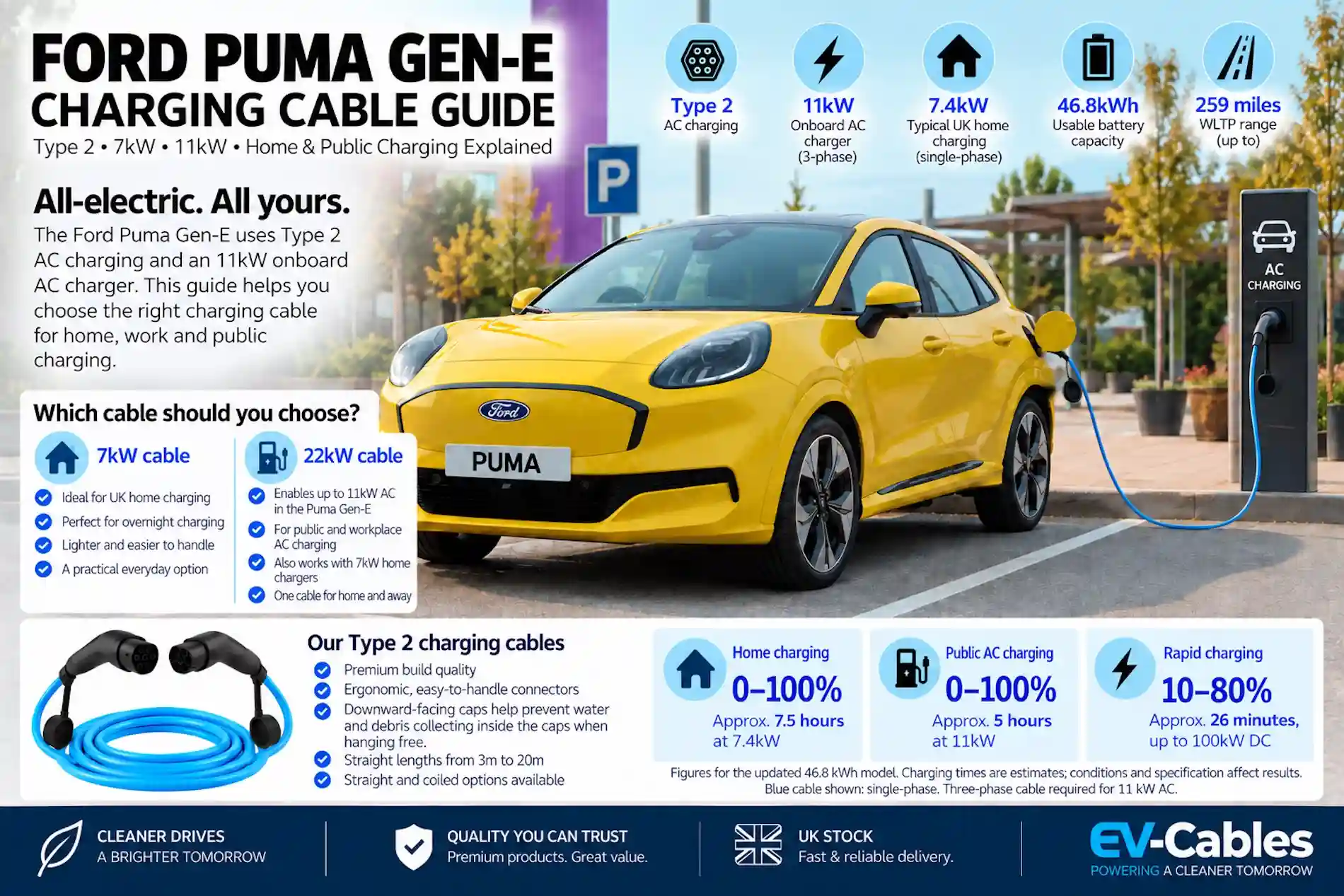
7kW vs 22kW, Charging Times, Cable Lengths & Real-World Advice
The Ford Puma hardly needs an introduction in the UK. It's been one of Britain's most popular cars for years.
The Puma Gen-E takes that familiar formula and removes the petrol engine altogether — and it's already attracting plenty of attention. Ford described the Puma Gen-E as the UK's best-selling electric vehicle so far in 2026 in early March.
But moving from a petrol Puma to the Gen-E introduces something you never had to think about at the petrol station:
Which charging cable do you actually need?
Ford supplies a Type 2 Mode 3 charging cable with the Puma Gen-E, so you're not starting from scratch. But the cable that comes with a car isn't necessarily the cable that best suits your driveway, workplace or the places you'll charge while travelling.
The current Puma Gen-E supports 11kW AC charging, while a typical UK home wallbox provides around 7kW. Then you'll encounter 11kW and 22kW public AC chargers, 100kW DC rapid charging and cables labelled 7kW or 22kW.
It sounds complicated.
It really isn't.
How Fast Can the Ford Puma Gen-E Charge?
The current Puma Gen-E has an 11kW three-phase AC onboard charger, so charging speed depends heavily on what you're plugged into.
| Charging method | Puma Gen-E capability | Approx. charging time |
|---|---|---|
| Domestic 3-pin socket | 2.3kW | ~24 hours 0–100% |
| Typical UK single-phase wallbox | 7.4kW | ~7½ hours 0–100% |
| Three-phase AC charger | 11kW | ~5 hours 0–100% |
| 22kW AC charge point | 11kW maximum | ~5 hours 0–100% |
| DC rapid charger | Up to 100kW | 10–80% in ~26 minutes |
The interesting number there is 11kW.
At home, most UK owners will be charging from a 7–7.4kW single-phase wallbox. That's perfectly adequate for overnight charging. Plug in when you get home and, in most everyday situations, the Puma will be ready long before you need it again.
But the Gen-E can also take advantage of 11kW three-phase AC charging at suitable workplace, hotel, destination and public chargers.
That's where cable choice starts to matter.
What Type of Charging Cable Does the Ford Puma Gen-E Use?
For AC charging, the Puma Gen-E uses the standard European Type 2 connection.
If you're using an untethered home wallbox or public AC charging point, you need a Type 2 to Type 2 EV charging cable.
For most owners, that leaves two sensible choices:
7kW / 32A single-phase Type 2 EV Cables
Ideal for a typical UK home wallbox.
22kW / 32A three-phase Type 2 EV Cables
Allows the Puma Gen-E to access its full 11kW AC capability when connected to a suitable three-phase charger.
That second one sounds slightly strange at first.
Why would you buy a 22kW cable for an 11kW car?
Why Use a 22kW Cable if the Puma Gen-E Only Charges at 11kW?
Because the 22kW figure describes what the cable is capable of carrying, not what it forces into the car.
A 32A single-phase Type 2 cable is commonly described as a 7kW cable.
A 32A three-phase Type 2 cable is commonly described as a 22kW cable.
The Puma's onboard AC charger can accept up to 11kW using three-phase AC.
So connect the Puma to:
7kW home wallbox + 7kW cable → around 7kW
11kW three-phase charger + 22kW cable → up to 11kW
22kW three-phase charger + 22kW cable → still up to 11kW
The car is the limiting factor in that final example.
There's also nothing wrong with using a 22kW three-phase cable on your 7kW home wallbox. It's backwards-compatible and the Puma simply takes the power available.
That makes a 22kW Type 2 cable particularly attractive if you want one cable that stays in the boot and works at home, work, hotels and public AC chargers.
[Browse 22kW three-phase Type 2 charging cables]
Is a 7kW Cable Enough for Charging a Puma Gen-E at Home?
For most owners, absolutely.
A typical UK domestic EV charger supplies around 7–7.4kW on single phase, so a 32A single-phase Type 2 cable is a natural match.
The Puma's 11kW capability doesn't make your 7kW wallbox any faster.
And if the car is going to sit on your driveway from 6pm until 7am, does it really matter whether a full charge theoretically takes around 7½ hours rather than five?
Probably not.
This is why we wouldn't automatically tell every Puma Gen-E owner to buy the highest-rated cable available.
A single-phase cable is generally lighter and easier to handle than an equivalent three-phase cable. If it spends its life attached to the same 7kW wallbox, that's a genuine everyday advantage.
[Browse 7kW single-phase Type 2 charging cables]
The Cable Ford Supplies Isn't Necessarily the Cable You'll Want
Ford includes a Type 2 Mode 3 charging cable with the Puma Gen-E.
That's good news.
But we'd still think about how you're actually going to use the car before deciding that the cable supplied in the boot is the only one you'll ever need.
A straightforward driveway with the wallbox beside the car is easy.
Real life can be rather less cooperative.
Perhaps two cars share the driveway.
Perhaps you reverse onto the drive sometimes and drive straight in at others.
Your wallbox might be beside the garage while the car ends up several metres away.
Then there are public chargers.
The only available bay might put the charging post on the wrong side of the car. Another vehicle may be parked awkwardly. Someone who isn't even charging may have occupied the bay you'd normally use.
Suddenly cable length matters considerably more than it did on the specification sheet.
What Length Charging Cable Should You Buy for a Ford Puma Gen-E?
Our advice is simple:
Don't measure from the charger to the car. Measure the route the cable actually needs to take.
3m
Useful where the charger and parking position are fixed and extremely close together.
It's compact and easy to store, but leaves very little margin when circumstances change.
5m
A good everyday home length where your wallbox is conveniently positioned.
For plenty of owners, 5m is all they'll ever need.
7.5m
This is where you start gaining useful flexibility without carrying a particularly long cable.
If you're buying one cable to travel with the car, 7.5m EV cable is a very useful compromise.
10m
This is the length we'd start considering seriously for mixed-use driveways and regular public AC charging.
A 10m cable can help when the charger is on the wrong side of the parking bay, when you can't park exactly where you'd like or when several cars share the same home charger.
It can also prove useful when travelling.
Imagine arriving somewhere with a bank of chargers and finding the most conveniently positioned bays occupied. You can't extend the tethered cable on a DC rapid charger, but if there's an untethered AC charging point available nearby, a longer Type 2 cable can give you considerably more freedom over where you park.
Obviously the cable still needs to be routed safely without creating a trip hazard or crossing somewhere it shouldn't.
But having extra reach gives you options that a short cable simply doesn't.
[Browse 10m Type 2 EV charging cables]
15m and 20m
These aren't necessary for most people.
But if you have a genuinely long driveway, several possible parking positions, a shared charging point or an awkward property layout, a long continuous Type 2 cable can solve problems that a standard cable simply can't.
We stock Type 2 cables up to 20 metres for exactly these situations.
And importantly, we don't recommend trying to extend a shorter EV cable later. If you need 15m or 20m, buy a cable manufactured as a continuous 15m or 20m charging cable.
[Browse 20m Type 2 EV charging cables]
Straight or Coiled Charging Cable for the Puma Gen-E?
Straight and coiled cables solve different problems.
If maximum reach is the priority, we'd choose a straight cable.
A 10m straight cable gives you close to its full length to work with, making it much more appropriate for long driveways, several parking positions or unpredictable public charging layouts.
A coiled Type 2 cable is about something different: everyday practicality.
The cable naturally retracts when it isn't stretched out, helping to keep more of it away from wet or dirty ground. There's less loose cable around the charging area, less opportunity for tangling and less cable to gather up when you've finished charging.
If you've ever unplugged an EV on a wet morning and then had to gather several metres of muddy cable before putting it into the boot, you'll immediately understand the appeal.
Keeping more of the cable off the ground can also reduce unnecessary dragging across concrete, gravel and other abrasive surfaces. And having less loose cable underfoot can reduce clutter and potential trip hazards around a regularly used charging area.
But there is an important trade-off.
A coiled cable's stated length isn't its usable reach.
Our 5m coiled Type 2 cable provides approximately 2m of practical working reach, while our 10m coiled cable provides approximately 4m.
That's why we wouldn't recommend a coiled cable to someone whose priority is simply reaching further.
Choose straight for distance.
Choose coiled for practical everyday handling, reduced tangling, cleaner handling and keeping more cable off the ground.
And coiled doesn't mean slower. Choose the appropriate 7kW single-phase or 22kW three-phase version and the charging capability is determined in exactly the same way as a straight cable.
[Browse coiled Type 2 EV charging cables]
Charging the Puma Gen-E at Work
This is one situation where the Puma's 11kW onboard charger becomes genuinely useful.
At home, shaving a couple of hours off an overnight charge often achieves very little.
At work it's different.
If your workplace has 11kW or 22kW three-phase AC charging, the Puma can accept up to 11kW with an appropriate three-phase cable.
Arrive in the morning, plug in and several hours at your desk can put a substantial amount of energy back into the battery.
The same applies to hotels, gyms, shopping centres and destination chargers.
That's why we'd lean towards a 22kW-rated three-phase cable for a Puma owner who regularly charges away from home, even though the car itself doesn't charge at 22kW.
What About Charging the Puma Gen-E on a 3-Pin Plug?
It can be done with an appropriate portable EV charger.
At around 2.3kW, however, you're looking at roughly 24 hours for a 0–100% charge.
That's not how we'd want to charge a Puma every day.
But as an occasional backup — perhaps you're visiting family, staying somewhere without an EV charger or simply need enough energy to get to a faster charger the following morning — a portable 3-pin charger can be extremely useful.
It's better thought of as the EV equivalent of carrying a spare can of fuel, rather than your primary charging solution.
What About DC Rapid Charging?
This is the easy one.
You don't need your Type 2 cable.
DC rapid chargers have their own permanently attached CCS charging cable.
The current Puma Gen-E can accept up to 100kW DC, with Ford quoting approximately 26 minutes from 10–80% under suitable conditions.
So when you're travelling long distance and stop at a motorway rapid charger, the Type 2 cable stays in the boot.
Your own cable becomes important again when you reach the hotel, workplace, car park or destination and find an untethered AC charger.
How Far Will a Ford Puma Gen-E Actually Go?
The current Puma Gen-E has a 53kWh gross battery, with approximately 46.8kWh usable, and Ford quotes up to 259 miles WLTP for the current model.
As with every EV, WLTP isn't a promise that you'll see exactly 259 miles every time you charge it.
Motorway speed, cold weather, heating, air conditioning, hills, driving style and even wheel choice can all influence consumption.
For planning purposes, we'd treat the official figure as a useful comparison rather than a guaranteed real-world distance.
The more interesting ownership question is usually:
How much range do I actually need to replace tonight?
If you've driven 40 miles during the day, you don't need to replenish the entire battery when you get home.
Plug into a 7kW wallbox for a few hours and you've comfortably replaced what you used.
That's why overnight home charging works so well even when the car itself is capable of faster AC charging.
What Should You Look for in a Puma Gen-E Charging Cable?
Charging speed is only part of the story.
A cable gets dragged over driveways, used in rain, thrown into boots, stepped around in car parks and repeatedly connected and disconnected for years.
We'd therefore look at the construction as well as the number printed on the label.
Our Type 2 cables use EV-specific flexible cable, correctly rated conductors and robust Type 2 connectors designed for repeated charging use.
We also use downward-facing protective plug caps.
The orientation is deliberate: when the cap is hanging free, its downward-facing design helps prevent rainwater, dirt and debris collecting inside it, whether the cable is being used or the cap is disconnected from the charging plug.
It's a small design detail, but exactly the sort of thing that starts making sense when a cable spends its life outdoors.
[Browse our Type 2 EV charging cables]
One Cable at Home and Another in the Puma?
This sounds unnecessary until the first time you arrive somewhere and realise the cable is still hanging beside your wallbox at home.
If you regularly use untethered public AC chargers, having a second cable permanently in the boot can be surprisingly convenient.
For a Puma Gen-E we'd consider:
Home: 5m or 7.5m 7kW single-phase cable if you're using a typical UK wallbox.
In the car: 7.5m or 10m 22kW three-phase cable for greater flexibility and access to the Puma's full 11kW AC capability when available.
Or, if your home charger is close to the car and you value cleaner everyday handling, a coiled cable at home and a longer straight cable in the boot is another practical combination.
Ford's Current Puma Gen-E Charging Offers
At the time of writing, Ford is promoting its Ford Power Promise with qualifying new Puma Gen-E purchases in Great Britain.
The current offer includes a home charger installation and charging-related benefits subject to Ford's eligibility criteria and terms.
Offers change, though — sometimes quite quickly — so we'd always check Ford's current terms rather than buying the car on the assumption that today's incentive will still exist when you order.
Ford Puma Gen-E current offers and charging information
So, Which Charging Cable Would We Buy?
If your Puma spends almost every night on the same UK 7kW wallbox:
Buy a 7kW 32A single-phase Type 2 cable.
If you regularly use workplace, hotel or public AC charging:
Buy a 22kW 32A three-phase Type 2 cable.
If you have an awkward or shared driveway:
Prioritise the correct straight cable length — potentially 7.5m, 10m, 15m or 20m.
If your charger is close to the car and you dislike handling loose, wet or dirty cable:
Consider a coiled Type 2 cable, remembering that its usable reach is considerably shorter than its nominal cable length.
And if you want one cable permanently in the Puma that gives you the broadest AC charging flexibility?
We'd choose a 7.5m or 10m 22kW three-phase Type 2 cable.
Not because the Puma can charge at 22kW.
It can't.
But because that cable lets the car use its full 11kW AC capability where available, while still working perfectly well on a normal 7kW home charger.


